


Reform of Corporatization of Municipal Enterprises: Kharkiv Hosted the Second Regional Training for Communities on the Implementation of Law No. 4196-IX
The series of training events for communities continues its journey across the country. Following a successful start in Kyiv, Kharkiv became the next venue for a professional discussion. It was here that the next training took place within the project "Implementation of the Reform of Management of Communally Owned Legal Entities under Law No. 4196-IX," implemented by EU-LEAP in partnership with the Community of Registrars of Ukraine, the Association of Ukrainian Cities, the All-Ukrainian Association of Amalgamated Territorial Communities, and with the support of JTI Ukraine.
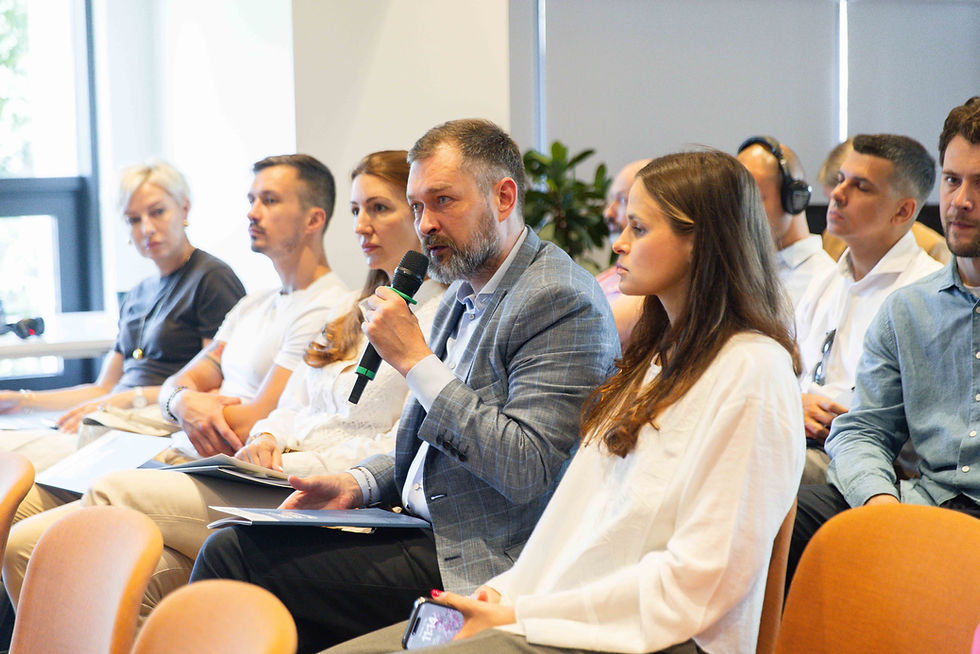
The event, held at the EVOHUB venue, brought together 91 participants — representatives of local self-government bodies and municipal enterprises from Kharkiv, Sumy, Poltava, and Luhansk regions.
Joining Forces for Effective Change
The primary goal of the training was to build a shared understanding among communities of the logic of the corporatization reform and to provide practical tools for transitioning to new management standards.
During his opening remarks, Oleksii Movchan, Member of the Verkhovna Rada of Ukraine and Deputy Chairman of the VRU Committee on Economic Development, emphasized the importance of direct engagement with communities in these regions:
"The reform of communal property management is complex and multifaceted, but it is critically necessary for the transparent operation of communities. I am well acquainted with the specifics of Kharkiv, Sumy, Poltava, and Luhansk regions, so I am particularly pleased to see such strong interest. Our task is to walk this path together. We will train everyone, provide the necessary guidance, and I am confident that everything will work out. Such trainings are a bridge between a legislative initiative and its successful implementation on the ground."
In turn, Oleksandr Slobozhan, Executive Director of the Association of Ukrainian Cities, emphasized the importance of feedback from communities:
"Thank you to the EU-LEAP team for these much-needed trainings. It is important for us to hear your practical remarks. All proposals received by the Association of Ukrainian Cities following the discussions will be processed in cooperation with Oleksii Movchan and other members of parliament. In accordance with the final provisions of the Law, we will propose the necessary amendments to enhance the effectiveness of communal property management and make this transition as comfortable as possible for municipalities."
An important partner of the event was the All-Ukrainian Association of Amalgamated Territorial Communities, which actively promotes the involvement of community representatives in the training with the aim of strengthening their capacity to implement new approaches to the management of communally owned legal entities.
A Practical Intensive: From Theory to Algorithms
The training program covered the full cycle of implementing the new Law — from explaining the philosophy of the reform to specific technical steps. Participants thoroughly examined the changes in approaches to the establishment of legal entities and the updated role of the owner in the management system. Considerable attention was given to the practical aspects of registration actions, in particular the procedures for the termination of municipal enterprises and their transformation into new business entities. A separate important focus was the discussion of property and land management, where specialists presented the specifics of transitioning to the new legal regime of usufruct and the algorithms for registering property rights during the transition period.
Lecturers also paid particular attention to common errors in documents, inventory acts, and matters of legal succession.
The project continues its work. We will be collecting participant feedback to improve methodological materials. Ahead lie new cities and new communities that will become part of the large-scale transformation of Ukraine's municipal sector.


Comments