


Round Table on "Discussion of Legislative Initiatives to Eliminate Land Schemes in the Development of State and Communal Land"
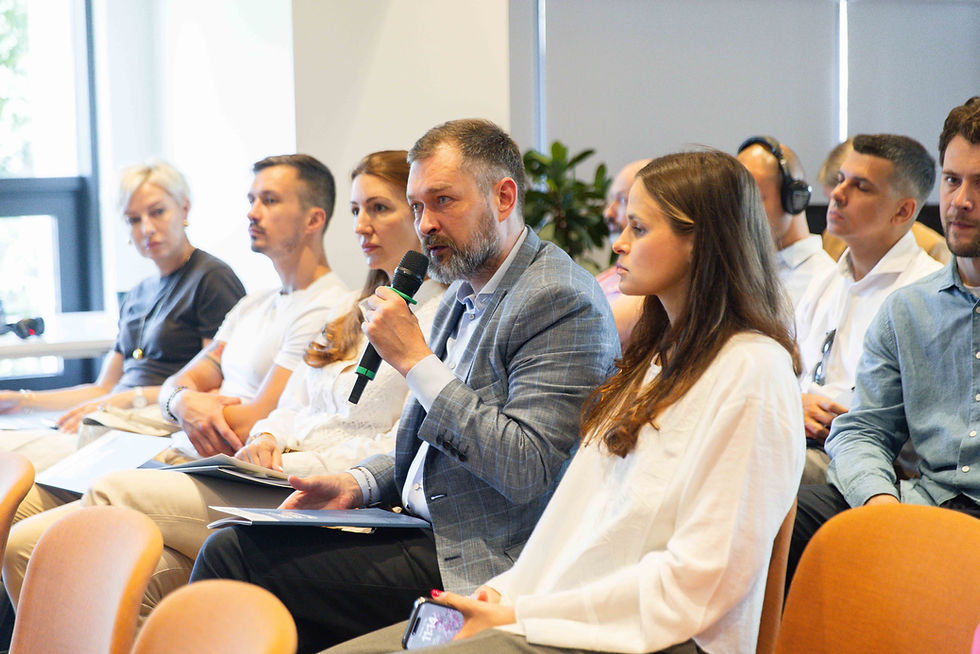
On April 9, 2026, a round table was held on the topic "Discussion of Legislative Initiatives to Eliminate Land Schemes in the Development of State and Communal Land." The event brought together representatives of the legislative and executive branches, the judicial system, law enforcement agencies, local self-government, state enterprises, the academic community, and international partners for a comprehensive discussion of one of the most sensitive areas — the use of state and communal land for development.
The discussion focused on finding effective solutions to eliminate legal gaps and practices that create preconditions for abuses, non-transparent schemes, and the loss of state assets. At the center of participants' attention were Draft Laws No. 14038 and No. 14039, as well as a broader range of possible legislative initiatives.
The event opened with a block dedicated to analyzing the issue of land schemes and legislative solutions to address them. Participants outlined the key shortcomings of current regulation that allow state and communal lands to be used outside competitive procedures, and also create opportunities for manipulation through changes in designated purpose, the conclusion of investment agreements, and other mechanisms.
Oleksii Movchan, Member of the Verkhovna Rada of Ukraine and co-author of the draft laws, Deputy Chairman of the VRU Committee on Economic Development, stated: "We are not discussing this problem for the first time — it has existed for decades and has still not been systemically resolved. Today we see that the problem has become public and is well known thanks to the work of anti-corruption bodies. The question is whether these are isolated cases or a systemic design flaw. We are convinced that this is precisely a systemic problem."
Oleksii Movchan noted that there are two key schemes: the development of state and communal lands through investment agreements and the so-called "toilet schemes."
Regarding the first: Draft Law No. 14038 proposes a simple logic — if it is truly a partnership, the public-private partnership (PPP) procedure applies. If not, land for development must be provided through an auction, followed by the standard investment agreement procedure. There should be no other "grey zones."
Regarding toilet schemes, Draft Law No. 14039 proposes limiting the area of the land plot to be granted for use in connection with a real estate object. The area required for servicing is to be determined by the Cabinet of Ministers. If this area is insufficient for the property owner, they participate in an auction to obtain use of or ownership over a larger portion of the plot.
Oleksii Movchan also separately noted that there are other proposals regarding the conclusion of investment agreements, namely by decision of the Cabinet of Ministers.
Special attention was paid to legislative gaps in the areas of urban planning and land relations, which, according to participants, create a systemic basis for non-competitive use of land resources. Such gaps allow transparent procedures to be bypassed, undermining trust in state institutions and creating significant corruption risks. Olena Shuliak, Member of the Verkhovna Rada of Ukraine and Chair of the VRU Committee on the Organization of State Power, Local Self-Government, Regional Development, and Urban Planning, drew attention to the risks arising from the absence of urban planning documentation: "The root of the problem today is the unwillingness of communities — especially those with budgets like the city of Kyiv at UAH 120 billion — to work on ensuring that modern documentation exists in the city, community, or municipality."
During the presentations, speakers discussed the consequences of ineffective management of state assets, including land plots of the National Academy of Sciences of Ukraine. It was noted that the absence of clear and transparent procedures for transferring land for development leads to a loss of control over strategic assets and creates risks of their effective withdrawal from state ownership.
"Over more than 20 years, the National Academy of Sciences of Ukraine has concluded 44 investment agreements, 20 of which were signed in the last 4 years, under which more than 130 hectares of land were transferred. The vast majority of agreements (34, or 77%) involve the development of 116.0 hectares of land in the city of Kyiv. This represents 8% of the total NAS land holdings. Instead of providing scientists with housing, the NAS receives non-residential space it has no need for under these agreements and leases it out, sometimes at a nominal fee. There are 650 people on the housing waiting list. Over the last 4 years, scientists have received only 107 apartments," — this data was presented to participants by co-author of the draft laws, Member of the Verkhovna Rada Andrii Puziichuk, Chairman of the VRU Temporary Special Commission on the Investigation of Possible Facts of Illegal Construction.
Dmytro Nataluha, who has served as Chairman of the State Property Fund of Ukraine since January 2026, shared his perspective on the use of state enterprise lands and his vision for addressing the issue: "The problem is extremely acute. One of the first things we did was launch an audit of investment agreements related to the assets on our register. The second was to halt any privatization processes that were proceeding not through auctions but through buyouts. Inspections are ongoing."
The second block of the round table addressed judicial and law enforcement aspects. Representatives of the judicial branch drew attention to the existence of legal conflicts that complicate the formation of consistent judicial practice.
Nataliia Shevtsova, Judge of the Supreme Court within the Cassation Administrative Court, drew attention to Draft Law No. 14039 and the need to clarify the jurisdiction of disputes arising in the procedure of transferring a land plot into ownership or use by an executive authority or local self-government body.
Yurii Chumak, Judge of the Cassation Commercial Court within the Supreme Court and Secretary of the judicial chamber for cases concerning land relations and property rights, spoke about judicial practice in disputes regarding the development of state and communal land. In his presentation, the judge analyzed the pitfalls of investment agreements concluded on lands held under permanent use by state enterprises and institutions. He also emphasized that the absence of clear legislative guidelines leads to ambiguity in decisions and complicates the protection of state and territorial community interests in court. Regarding "toilet schemes," the judge noted: "I see a problem that needs to be resolved legislatively — to establish the maximum required size of a plot for servicing real estate property."
Liudmyla Kozlovska, Doctor of Legal Sciences, Associate Professor, and Head of the Analytical and Legal Work Department of the Grand Chamber of the Supreme Court, drew the attention of legislators present to other similar land schemes: "In addition to 'toilet schemes,' there are also 'asphalt schemes.' These involve lands held under permanent use (for example, hospitals). Since land cannot simply be leased out without a tender, agreements are concluded for an 'asphalted area' as a separately defined asset." The expert also shared an example of a dam through which a road of national significance passes being privatized for UAH 2,000, despite an assessed value of UAH 2 million: "Hydraulic structures must by law remain exclusively in state or communal ownership, since a dam cannot exist without a water body. The privatization of a dam is covert use of a water fund asset."
Vladyslav Shypovych, Judge of the Cassation Civil Court within the Supreme Court, summarized the presentations of the second block's participants and noted that the problem is easier to resolve preventively: "Once a plot has been built on and apartments have been sold, it is too late to resolve the issue. The root of the problem needs to be addressed. In this context, I find the legislative initiatives presented appealing, as they are also aimed at preventing the consequences."
Nataliia Vasylenko, Deputy Head of the Department for Representing State Interests in Court at the Office of the Prosecutor General, spoke about the need to enter information on land and its designated purpose into land cadastres: "In order to prevent alienation, the state must make efforts and provide the necessary information in the cadastre — and this is a lengthy process requiring significant resources. The land cadastre serves as the source of information for all other purposes — urban planning, notaries, registrars. Everyone relies on the land cadastre. The root cause of many problems is that the state has not carried out land management and regime lands lack the safeguards built into land cadastres. If they existed, there would not be such straightforward cases involving transactions and the possibility of their alienation."
Viktor Yarema, Deputy Head of the Third Detective Unit of the Third Main Detective Division of NABU, shared conclusions regarding corruption schemes in the area of land relations, in particular the use of investment agreements. The detective reminded those present that a permanent user must use land for its statutory purposes: "If you were given land for science, use it for science, and do not build housing. A person who wants to build is effectively declaring that they do not wish to use the land for its statutory purposes. And there is a mechanism for them — to relinquish permanent use in favor of the owner, which is either an amalgamated territorial community or the Cabinet of Ministers. Then we have auction mechanisms through which everything can be conducted transparently." The detective also mentioned positive examples of land use, including the establishment by the State Property Fund of the LLC "State Land Bank," which became the first state operator of agricultural lands and introduced sub-leasing of state lands through transparent auctions.
Volodymyr Urazovskyi, Senior Detective of the Third Detective Unit of the Second Main Detective Division of NABU, spoke about "toilet schemes" and supported previous speakers regarding the need to develop a methodology for determining the area required for servicing real estate property and the availability of urban planning documentation, also noting that such a methodology could begin to be developed today.
The third block was dedicated to the implementation of decisions by individual enterprises or bodies within the framework of current legislation and the assessment of their practical effectiveness.
Danyiil Fedorchuk, Director of Legal Affairs at JSC Ukroboronprom, shared how the company independently regulates land relation issues: "A standard clause was added to the charters of all our enterprises: the enterprise has no right to conclude any agreements related to construction, except those directly connected to core activities — the development, production, repair, modernization, and disposal of weapons. Everything else is 'from the devil.' If you have surplus land — transfer it to state or local authorities. It will benefit us too, since taxes will be lower. It was also established that all actions related to the division of land plots require approval from JSC Ukroboronprom. The charters also provided that both significant transactions and any transactions related to real estate, regardless of their value, are subject to approval. Everything goes through approval."
Viktoriia Ptashnyk, a deputy of the Kyiv City State Administration and author of the project, described the new anti-corruption land rules introduced in Kyiv: "In the rules, we used State Building Codes. We established a procedure for verifying the size of the plot granted for servicing real estate without an auction. Some developers are preparing to challenge this in court. Nevertheless, we defined how the land commission and the land resources department of the Kyiv City State Administration should respond upon identifying that the size of a land plot exceeds the size required for servicing the relevant property."
Leonid Yemets, a deputy of the Kyiv City Council, supported his colleague and described other safeguards embedded in the new rules: "We established a mandatory requirement to observe the order of review of applications for the transfer of a plot into ownership — that is, deputies must review cases consecutively, in the order in which they were received by the council."
In the concluding part of the event, experts from the academic community provided a scientific and legal assessment of the proposed legislative changes. They emphasized the importance of a systemic approach to reform, the consistency of new norms with existing legislation, and ensuring a balance between the interests of the state, business, and communities.
Volodymyr Pospolitak, Candidate of Legal Sciences, Associate Professor of the Department of Private Law at the Center for Civil Law Studies of the National University of Kyiv-Mohyla Academy, who also participated in the drafting of the legislation, noted that "problems generally arise from inequality within equality. Therefore, everyone in their role — whether deputies in drafting laws or law enforcement agencies in exercising their powers — must identify where inequality exists within that equality. At the same time, Draft Law No. 14038 addresses this inequality within competitive selections and competitive realization of land rights."
Pavlo Kulynych, Corresponding Member of the National Academy of Legal Sciences of Ukraine, analyzed and summarized the presentations of previous speakers and their comments on the draft laws. In his address, he also emphasized the need for further reforms: "The work done is correct, but we will only close a few corruption schemes on the body of our land legislation. A few important 'bleeding wounds,' but these are just a few schemes. What else do we need to do? This has already been mentioned today, and I will simply repeat it: we must finally adopt a law on the transformation of the right of permanent use into another form of right. This is an institution of the Soviet era and has effectively outlived its purpose."
The round table served as a platform for open dialogue among all stakeholders and allowed not only the key problems to be outlined but also a shared vision of further steps to be formed. Participants agreed that the effective elimination of land schemes is only possible through comprehensive changes combining legislative innovations, institutional capacity, and proper law enforcement practice.
The event was organized by the analytical center EU-LEAP with the support of the Committee of the Verkhovna Rada of Ukraine on Economic Development.


Comments