

EU-LEAP research
REFORMING PUBLIC UTILITIES: A Practical Guide for Communities
The EU-LEAP Analytical Center, in collaboration with the NGO “Community of Registrars,” has prepared a guide titled “Reforming Municipal Enterprises,” which will help communities organize their efforts to implement Law of Ukraine No. 4196-IX.
The publication provides explanations and practical tools regarding:
• the preparation and implementation of decisions to dissolve municipal enterprises as part of the reform process;
• state registration of the dissolution of an enterprise and the creation of a legal entity as a result of the transformation;
• the use of usufruct rights over state and municipal property;
• the registration of rights to land plots.
This material will be useful to community leaders, specialists in legal, property, and land departments, managers and accountants of municipal enterprises, members of reorganization commissions,
and state registrars.

METHODOLOGY FOR ASSESSING THE ALIGNMENT OF CORPORATE GOVERNANCE REFORMS IN STATE-OWNED ENTERPRISES WITH EUROPEAN COMMISSION REQUIREMENTS AND ASSESSMENTS AND OECD STANDARDS
The methodology (analytical framework) draws on three analytical papers prepared by the EU-LEAP think tank: (1) an analysis of the OECD Guidelines on Corporate Governance of State-Owned Enterprises 2024; (2) an analysis of the European Commission’s Commission Staff Working Document: Ukraine 2025 Report; and (3) an analysis of the Ukraine Plan under the Ukraine Facility (2024–2027), focusing on corporate governance in state-owned enterprises. It also draws on an analysis of the OECD Review of the Corporate Governance of State-Owned Enterprises in Ukraine 2026 and the G20/OECD Principles of Corporate Governance 2023.
The methodological choices concerning indicator coding, the two-component assessment scale, aggregation rules and levels of evidence form part of this framework. They do not replace the substance of the relevant international documents but provide a structured approach to applying them in the Ukrainian context.

PUBLIC LAND BETWEEN EXEMPTIONS AND COMPETITION. LEGAL MECHANISMS, RISKS AND FINANCIAL CONSEQUENCES OF ACQUIRING AND DEVELOPING PUBLIC LAND WITHOUT LAND AUCTIONS
Ukrainian land legislation is based on the principle of competitive disposal of state-owned and municipally owned land and rights to such land. The exemption for building owners is intended to provide the land needed for the use and maintenance of existing property. Risks arise when a small or functionally ancillary structure is used as a legal basis for obtaining a substantially larger land plot for new construction without a land auction. In public debate, this practice is known as the “toilet scheme”, although this term does not appear in legislation.
The study examines two mechanisms for making public land available for private development: the acquisition of land without a competitive procedure by the owner of a property located on it, and development through an investment agreement involving a state-owned or municipal enterprise or institution.
The analysis focuses on the legal structure, criteria applied by the courts, economic substance and amendments proposed in Bills No. 14038 and No. 14039.

ANALYSIS OF THE OECD GUIDELINES ON CORPORATE GOVERNANCE OF STATE-OWNED ENTERPRISES (2024) IN THE UKRAINIAN CONTEXT AND THE OECD REVIEW OF THE CORPORATE GOVERNANCE OF STATE-OWNED ENTERPRISES IN UKRAINE 2026
The analysis of the OECD Guidelines on Corporate Governance of State-Owned Enterprises 2024 and the OECD Review of the Corporate Governance of State-Owned Enterprises in Ukraine 2026, together with a comparison against the findings of the European Commission’s Ukraine 2025 Report, shows that Ukraine has made substantial progress in recent years in aligning its legal framework for the governance of state-owned enterprises with international corporate governance standards. At this stage, however, the main challenge lies less in further expanding the legal and regulatory framework than in ensuring the full, consistent and uniform implementation of the mechanisms already introduced across the entire portfolio of state-owned enterprises.
The OECD’s 2026 Review confirms that Ukraine’s legal framework has moved substantially closer to this model. However, implementation of the reform remains uneven, with outcomes differing significantly between the largest state-owned enterprises and the rest of the sector.

DEVELOPING THE MUNICIPAL BOND MARKET IN UKRAINE: RECOMMENDATIONS FOR IMPROVING ITS FUNCTIONING
Rebuilding Ukraine’s destroyed infrastructure requires funding that no single financing mechanism can provide. According to the estimate by the World Bank, the European Commission and the United Nations presented in the Fifth Rapid Damage and Needs Assessment (RDNA5) in February 2026, Ukraine’s total recovery and reconstruction needs over the next decade amount to approximately US$587.7 billion, nearly three times Ukraine’s GDP in 2025. The scale of these needs calls for a diversified recovery financing system capable of combining domestic and external sources, public and private capital, and channelling them effectively into long-term investments.
Municipal bonds are an effective financial instrument widely and successfully used in most countries around the world. International experience confirms the significant role of bonds in subnational debt financing.

ASSESSING THE READINESS OF THE KAMIANETS-PODILSKYI URBAN TERRITORIAL COMMUNITY FOR A PILOT ISSUE OF DOMESTIC MUNICIPAL BONDS
Research into the development of Ukraine’s municipal bond market includes a comprehensive analysis of the market’s current state and functioning, its legal and regulatory framework, the financial capacity of local communities, and international experience with municipal bonds. Earlier stages of the research examined local borrowing practices in Ukraine between 1995 and 2021, the current legal and regulatory framework, and the financial capacity of five of Ukraine’s largest cities with experience in, or the potential for, using this instrument. They also included an analysis of international models of municipal debt financing and the scope for adapting them to Ukrainian conditions.
The next stage involved a practical assessment of the feasibility of applying the approaches developed at the level of an individual community. The Kamianets-Podilskyi Urban Territorial Community was selected for this analysis, which assessed its financial, borrowing, institutional and project development capacity as a potential issuer of domestic municipal bonds.

INTERNATIONAL EXPERIENCE WITH MUNICIPAL BONDS: COMPARATIVE ANALYSIS AND LESSONS FOR UKRAINE
This publication was prepared by the EU-LEAP think tank (EU-LEAP NGO), which is implementing the project “Developing the Municipal Bond Market in Ukraine: Analysis of Regulation, Practice and Potential for Community Recovery” with the support of the Askold and Dir Fund, administered by ISAR Ednannia under the project “Strong Civil Society of Ukraine – a Driver of Reforms and Democracy”, funded by Norway and Sweden.
The sections covering the experience of the United States, Mexico and Australia were prepared jointly with students of Stanford University’s Ford Dorsey Master’s in International Policy programme as part of their capstone research project.
The content of this publication is the responsibility of the EU-LEAP think tank (NGO EU-LEAP) and does not reflect the views of the Governments of Norway and Sweden or ISAR Ednannia.

ANALYSIS OF THE UKRAINE PLAN UNDER THE UKRAINE FACILITY (2024–2027) REGARDING THE IMPLEMENTATION OF CORPORATE GOVERNANCE IN STATE-OWNED ENTERPRISES
The EU-LEAP think tank analysed the provisions of the Ukraine Plan under the Ukraine Facility (2024–2027) concerning the implementation of corporate governance in state-owned enterprises. The EU-LEAP team examined the progress made towards meeting the relevant Plan indicators, the tasks that remain outstanding, and why the practical implementation of the reform matters for the economy and European integration.
The EU-LEAP study examines four interrelated areas of reform:
-
adoption of a state ownership policy;
-
improvement of the governance of state-owned enterprises;
-
separation of activities carried out to fulfil public service obligations from activities unrelated to those obligations;
-
improvement of the state aid control system.

ANALYSIS OF THE EUROPEAN COMMISSION’S
“COMMISSION STAFF WORKING DOCUMENT
UKRAINE 2025 REPORT”
The report is comprehensive in nature and assesses not just a single sector, but Ukraine’s overall progress toward meeting the requirements for membership in the European Union. It analyzes the political, economic, legal, and institutional changes that have taken place in Ukraine during the reporting period, particularly amid the ongoing full-scale war. The document covers issues related to the functioning of democratic institutions, public administration, the rule of law, the fight against corruption, economic criteria, competition, state aid, energy, healthcare, transportation, financial control, and other areas relevant to the negotiation process for Ukraine’s accession to the EU.
The main purpose of the report is to assess the extent to which Ukraine is adapting its legislation and institutional system to European Union standards, particularly under martial law. The document emphasizes that despite the full-scale war, Ukraine is demonstrating unprecedented political will for integration.

ANALYSIS OF REGULATION OF TEMPORARY STRUCTURES, PARKING, MARKETS AND FAIRS, ADVERTISING AND ELECTRIC CHARGING INFRASTRUCTURE in Kyiv, Lviv, Odessa, Poltava and Dnipro
The EU-LEAP think tank has investigated local regulation of commercial use of urban space in Kyiv, Lviv, Odessa, Poltava and Dnipro. The analysis is based on official responses from local governments and municipal enterprises, attached local acts, as well as on the current national legal framework.
The subject of the study is not the quality of the cities' responses, but the models by which communities grant the right to place and operate commercial facilities in urban space, determine fees, keep records, exercise control, and generate budget or quasi-budgetary revenues. The areas studied are parts of one management problem: access of private entities to limited urban resources - land, elements of landscaping, places on streets, and objects of municipal property.

ANALYSIS OF THE FINANCIAL CAPACITY OF COMMUNITIES AND INSTITUTIONAL CONDITIONS FOR THE ISSUE OF MUNICIPAL BONDS
Kyiv, Lviv, Odesa, Dnipro, Kharkiv 2023-2025
The analysis is based on official reports on budget execution for 2023-2025, data from the state budget web portal, local debt management programs for 2025, and domestic and global credit ratings of seven urban territorial communities — Kyiv, Lviv, Odessa, Dnipro, and Kharkiv.
The material was created by the EU-LEAP think tank (NGO EU-LEAP), which implements the project “Development of the Municipal Bond Market in Ukraine: Analysis of Regulation, Practice and Potential for Community Reconstruction” with the support of the Askold and Dir Foundation, administered by ISAR Unity within the framework of the project “Strong Civil Society of Ukraine – a Driver of Reform and Democracy” funded by Norway and Sweden.
The content of the material is the responsibility of the EU-LEAP think tank (NGO EU-LEAP) and does not reflect the views of the governments of Norway, Sweden or ISAR Ednannia.

LOCAL BOND MARKET IN UKRAINE:
Analysis of the practice of issuing local bond bonds in Ukraine in 1995-2021
The subject of the analysis is the actual parameters of local bond issues by Ukrainian issuing cities: issue volumes, years of issue, placement and repayment status, as well as the presence or absence of documentary confirmation of the relevant transactions.
The material was created by the EU-LEAP think tank (NGO EU-LEAP), which implements the project "Development of the Municipal Bond Market in Ukraine: Analysis of Regulation, Practice and Potential for Community Reconstruction" with the support of the Askold and Deer Foundation, administered by ISAR Unity within the framework of the project "Strong Civil Society of Ukraine - a Driver of Reforms and Democracy" funded by Norway and Sweden.
The content of the material is the responsibility of the EU-LEAP think tank (NGO EU-LEAP) and does not necessarily reflect the views of the governments of Norway and Sweden or ISAR Ednannia.

Analysis of Legislation on Local Government Bonds in Ukraine.
The study examines the legislation governing the issuance and trading of municipal bonds in Ukraine. It covers local borrowing requirements, procedures for approving and registering bond issues, budgetary constraints, taxation of investors’ income, and debt servicing and repayment. Particular attention is paid to legal barriers to market development and areas for regulatory improvement that could expand local communities’ access to financing for recovery and development.
This publication was prepared by the EU-LEAP think tank (EU-LEAP NGO), which is implementing the project “Developing the Municipal Bond Market in Ukraine: Analysis of Regulation, Practice and Potential for Community Recovery” with the support of the Askold and Dir Fund, administered by ISAR Ednannia under the project “Strong Civil Society of Ukraine – a Driver of Reforms and Democracy”, funded by Norway and Sweden.

Property of All-Union Public Organizations
This research is dedicated to the analysis of the legal regime of property that, as of August 24, 1991, was under the jurisdiction of all-union public organizations of the USSR on the territory of Ukraine. The study examines the mechanisms of transformation of this property from state ownership to private ownership through decisions of local self-government bodies and the organizations themselves, which frequently contradicted the legislation. The judicial practice regarding the recovery of such assets into state ownership is analyzed, and the problematic aspects of identifying legal succession are highlighted. The findings of the research contain recommendations for improving regulatory governance, in particular in the context of supporting Draft Law No. 6420.

Presentation of the Concept for Introducing a New Legal Regime for the Use of Sites for the Placement of Stationary and Mobile Temporary Structures, Fairs, Exhibitions, Parking Areas, and Outdoor Terraces
Presentation of conceptual proposals for updating legal frameworks governing the placement of temporary structures for business activities, fairs and exhibitions, summer retail spaces, and parking areas.
The concept was developed by the EU-LEAP Analytical Center with the support of the EU Anti-Corruption Initiative in Ukraine (EUACI).
The All-Ukrainian Association of Local Self-Government Bodies “Association of Ukrainian Cities” and its members contributed to the development of proposals for the concept.

Research into the current state of the shadow market in Ukraine and recommendations for de-shadowing
The relevance of the analysis of shadow processes is due to their destructive impact on macroeconomic stability and the social sphere of Ukraine. The set of challenges - from military aggression to the demographic crisis - requires the immediate development of de-shadowing strategies to fill the budget and implement state programs. An important aspect of the study is also the harmonization of Ukrainian legislation with EU norms, which involves the eradication of informal employment and strengthening institutional capacity. Thus, studying the nature of the shadow economy is a necessary condition for the formation of effective state policy.

Analysis of the financial and technical condition of the municipal infrastructure of the city of Kyiv and the effectiveness of the Public Service Contract (PSC) model
Ukraine's municipal infrastructure is in a state of systemic technical and financial degradation. The majority of urban utility sectors — including district heating and thermal energy supply, hot and cold water supply, centralized water supply and sewerage, as well as municipal solid waste collection and management — are operating at the limits of their technical and financial capacity. Over an extended period, the infrastructure has been maintained with limited investment in modernization, resulting in significant deterioration of fixed assets, increasing network failure rates, resource losses, and the gradual accumulation of an infrastructure deficit.

Analysis of the problem of selling seized assets in enforcement proceedings and development of the most optimal solution
This analysis was prepared by the civil society organization "EU-LEAP" as part of developing proposals submitted to the National Agency on Corruption Prevention for consideration during the preparation of the draft Anti-Corruption Strategy and the draft State Anti-Corruption Program for 2026–2030. The sale of seized assets is a key instrument for enforcing court decisions and returning assets to the state; however, the sector remains vulnerable to corruption risks due to a lack of transparency, limited competition, and unclear delineation of authority among central executive bodies. The absence of unified auction standards, duplication of functions, weak oversight, and legislative constraints lead to abuses, budget losses, and erosion of public trust. Despite the availability of effective electronic solutions, competition and transparency in this area have yet to be ensured, highlighting the need for institutional reform.

Analytical Note on the Assessment of Ukraine's Progress in Meeting EU Requirements Based on Cluster Analysis (based on the European Commission Report "COMMISSION STAFF WORKING DOCUMENT Ukraine 2025 Report")
On November 4, 2025, the European Commission published its annual Ukraine 2025 Report, containing a comprehensive assessment of Ukraine's progress in meeting EU membership criteria and the degree of legislative alignment with the acquis. The document covers all six reform clusters, analyzing the state of political, economic, and sectoral changes amid the ongoing war. EU-LEAP conducted an analysis of the key findings and recommendations of the European Commission. The document outlines areas where Ukraine has demonstrated substantial progress — particularly in macroeconomic stability, digitalization, customs reform, modernization of the financial control system, and the development of sectoral policies. At the same time, a number of areas — judicial reform, anti-corruption policy, market surveillance, food safety standards, social policy, environmental regulation, and public procurement — require considerably faster advancement and institutional strengthening.

Training materials for the webinar "Specifics of Regulating the Activities of Municipal Enterprises in Communities during the Implementation of the Provisions of the Law of Ukraine No. 4196-IX dated January 9, 2025
The Civil Society Organization "Community of Registrars" prepared training materials for the webinar "Specifics of Regulating the Activities of Municipal Enterprises in Communities during the Implementation of the Provisions of the Law of Ukraine No. 4196-IX dated January 9, 2025" on matters of state registration of legal entities and state registration of property rights to real estate following the expiration of the Commercial Code of Ukraine, which was organized with the support of the Committee of the Verkhovna Rada of Ukraine on Economic Development, with the participation of the analytical center "EU-LEAP", the All-Ukrainian Association of Local Self-Government Bodies "Association of Ukrainian Cities", the Civil Society Organization "Club of Mayors", and JSC "Prozorro.Sales".
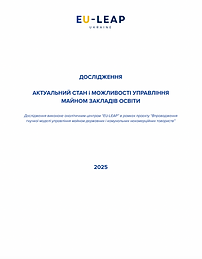
Research on the Current State and Asset Management Opportunities of State and Communally Owned Educational Institutions
The conducted research confirms that the issue of asset management of educational institutions in Ukraine is systemic rather than fragmented in nature. It encompasses both the state and municipal levels simultaneously and is the result of a combination of three interrelated factors: a rigidly centralized legal regime governing assets, the absence of real incentives and instruments for educational institutions to effectively manage their assets, and a sustained demographic decline that reduces the actual demand on educational infrastructure. It is precisely this combination of factors that leads to the accumulation of a significant volume of real estate that is either unused, used for unintended purposes, or fails to generate adequate social and economic returns.
Concept for the Implementation of OECD Corporate Governance Principles into Ukrainian Legislation in the Field of Management of Communally Owned Legal Entities
The concept presents the guiding principles of the Organisation for Economic Co-operation and Development, the compliance of Ukrainian legislation with the OECD principles in the field of management of communally owned legal entities, their application in regulating the management of municipal enterprises and non-entrepreneurial societies, the state of implementation of the relevant provisions, and proposals for their improvement through the development of a separate draft Law on the introduction of corporate governance elements in the municipal sector. The concept was developed within the framework of the project "Corporate Governance in Municipal Enterprises", implemented by the EU Anti-Corruption Initiative in Ukraine (EUACI).

Concept for Updated Legislation in the Field of Software Registrars of Settlement Operations (SRSO)
The concept was developed by the analytical center "EU-LEAP" with the purpose of forming updated regulation in the field of software registrars of settlement operations (SRSO).
The document is based on analytical findings regarding the current state of the SRSO market, the needs of businesses and the state in enhancing transparency, stability of technical infrastructure, and legal certainty. The concept was prepared in collaboration with the Association of SRSO Providers and other market participants.

Concept for the Implementation of Corporate Governance Instruments in Municipal Enterprises
As of January 1, 2025, Ukraine has 13,901 municipal enterprises. Approximately 100 of them are large critical infrastructure enterprises providing services in the areas of water supply, heat supply, and public transport in the largest cities of Ukraine. However, based on the results of the analysis, the management of municipal enterprises in the majority of cases does not meet OECD standards, and corporate governance elements are absent.
The concept presents the key reform blocks in the field of municipal enterprise management, focused on transparency, accountability, external oversight, and internal control. The concept was prepared by the analytical center "EU-LEAP" within the framework of the project "Corporate Governance in Municipal Enterprises", implemented by the EU Anti-Corruption Initiative in Ukraine (EUACI).

Comparative Analysis of Ukrainian Legislation in the Field of Municipal Enterprise Management with Best Corporate Governance Practices of EU Member States
The analysis was prepared with the aim of examining current legislation in the field of management of communally owned legal entities, identifying legal gaps and ambiguities, as well as developing proposals for improving the regulatory framework and implementing the OECD corporate governance principles in the activities of such legal entities. The analysis was prepared by the analytical center "EU-LEAP" within the framework of implementing corporate governance reform in municipal enterprises with the support of the EU Anti-Corruption Initiative in Ukraine (EUACI).
